Rosemary's Baby Ending Rosemary's Baby Ending Scene Meme
The Terror Within: 'Rosemary'southward Baby' and 'Black Swan' Past Alissa Wilkinson

Baby girls get swaddled in pink, all sweetness and low-cal, cooing little bundles of cotton candy. Nosotros sing them lullabies, play melodies on music boxes that cradle spinning ballerinas, nestle them between pillows and puffy stuffed rabbits. They grow. They pull on tiny pink tutus and soft pink sail slippers and spin on their toes, glowing with joy. They grow. They accept soft, cooing babies of their own.
Invert these saccharine trimmings of infancy and girlhood, though, and they abound sinister—a photonegative of innocence, a fleeing from the light. The opening titles of Rosemary'south Baby indicate that such an inversion is happening before our optics. While a pinkish script announces what you're about to see in a self-consciously girlish way, the eerie, wordless lullaby prickles your neck, and the camera's perspective—hovering and descending over Manhattan—implies that a presence is almost to alight, one time it finds its mark: The Bramford, where Rosemary and her married man Guy are looking to rent an apartment and, soon, starting time a family unit.
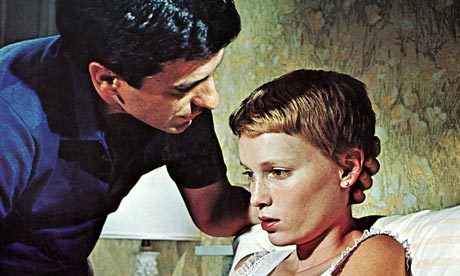
I don't know what it'southward like to sentry Rosemary'southward Babe in a human'southward body, but I know my body thrills sickeningly with cardinal terror. Mia Farrow's Rosemary seems at first both scrappy and brave; she chooses the flat, she initiates sexual practice, she oversees renovations, she is confident and happy and plenty capable of continuing up to others if she wants. She isn't a model of 20-beginning century feminism, but she'south no shrinking violet, either.
Withal her body, growing another being, undoes her. Impregnated without her own participation—either by Satan or by her husband, who cheerfully informs her the morning after that she'd passed out then he'd simply gone alee anyhow—she rapidly becomes merely a vessel, to exist shaped and scolded past everyone else: Guy, doctors who tell her not to read, Minnie Castavet and her foul smoothies. And maybe Satan's spawn, from the inside.
The longer this goes on, the more isolated Rosemary becomes. She's not a prisoner in her flat, merely she seems like i, with her billowy parcel of joy turned to tiny jailer within. Guy roams freely, and and so do the Castavets, who seem to be everywhere. But Rosemary is basically housebound, left alone in the domestic realm with her thoughts, her fears, her pains, and the sounds she hears through the walls. It'south a recipe for disaster.
In an essay included with the Criterion release of Rosemary's Baby, Ira Levin explained the origin of his novel. "Having observed that the near suspenseful part of a horror story is earlier, not afterwards, the horror appears," Levin wrote, "I was struck i day past the thought … that a fetus could be an constructive horror if the reader knew it was growing into something malignly different from the babe expected. 9 whole months of anticipation, with the horror inside the heroine!"

Levin—and others since him—suggest that what's frightening about Rosemary's Baby is that she is carrying the devil's child. Merely that's a reddish herring. You don't know most of the time whether what'due south happening to her is real or in her head, and it doesn't affair. The horror comes from a perfectly natural bodily experience gone horribly wrong, something every woman fears. The final scene is more catharsis than climax; if it had ended with a perfectly normal nascency, and it turned out Rosemary was imagining things all forth, the story of her nine months of agony might even accept been more frightening. What's scariest is that Rosemary's physical and emotional transformation, her exhaustion and pain, her paranoia, seem as plausible whether or not the Prince of Darkness has anything to do with it. Whatever is inside her gives others license to poke, prod, and pour tannis root down her throat; she is inhabited, and her womb's tenant messes with those qualities most fundamental to her.
By the time she reaches that excruciating telephone booth scene, Rosemary has been hollowed out, reduced to a raving madwoman, talking to the being inside her. Watching her darting optics and panicked receiver-clutching, I experience conflicted: I know she'due south completely justified, but I guess her all the same. Can't she just end freaking out?
***

When Darren Aronofsky's Black Swan was still just the subject of speculation—would information technology exist a dance movie? a horror movie? high camp? —star Natalie Portman told an MTV News reporter that the flick was "very unique in tone," "a psychological thriller" she compared to Rosemary's Infant. Aronofsky echoed the sentiment in interviews. Afterward, critics would compare Barbara Hershey'south performance as the ultimate ballet mom to Ruth Gordon's every bit Minnie Castavets, all malignant concern and poisonous presence. Black Swan's prologue starts not in the air just on the ground, with pink toe shoes tapping across the floor, as symbolic of delicate femininity as any curling typeface.
Portman'south Nina is as much an ingenue as Farrow's Rosemary, though without Rosemary's assertiveness. Nina is locked in her trunk, well-suited to portray the White Swan in Swan Lake not because she is particularly good, but considering she lacks the imagination to be wicked. Nina is virginal and repressed; her babyhood bedroom has been preserved well into her twenties, populated past stuffed animals and a ballerina music box, the soundtrack to her sleep. She spends her days at rehearsal and her nights stitching toe shoes at dwelling with Mommy. And her transformation does not involve pregnancy.
Or does it? The pic is purposely oblique about what is "actually" going on, and I don't mean to suggest that Nina is carrying a fetus. But at least part of Aronofsky's metaphor is that creative creation is a procedure like birth. Information technology requires a sacrifice of cocky, a transformation, passion alike to something sexual, to bring forth a new life. In Nina'due south case, that life is clawing to become out (and has been a while, if the scratching episodes in the past to which her mother alludes are from the same cause). It breaks through her skin and her fingernails. It appears equally a doppelganger—traditionally a harbinger of death—in the darkened windows of the subway, and eventually in Nina's mirrors.

The identity of the "it" infesting Nina remains fluid, but "its" manifestations expect like Rosemary's. Nina loses weight. She feels pain. Her body is affected. She manifests a host of mental health issues, from schizophrenia to OCD. She lashes out at her female parent. She becomes paranoid, certain that someone wants to steal her baby—her role equally the Swan Queen, in this case—and is deliberately sabotaging her to that stop. Anybody is a suspect. She tin can't trust anyone. Again, I'one thousand in her mind, believing she is being pursued. And and then I listen to her talk, and feel the aforementioned disharmonize. Tin't she but loosen up and take some fun?
***
1 could understand both Rosemary's Baby and Black Swan as following the contours of witch stories: an innocent woman is oppressed by men, and gains power only when she gives herself over to evil, whether that's the devil or a Black Swan. Certainly that moment of surrender appears in both films—Nina's in the dressing room, and Rosemary'south at the human foot of the bassinet.
Just the indelible horror of these movies is virtually more than oppression or evil. It'due south worth noting that two films which parallel Black Swan in a number of ways—Birdman and Whiplash—treat the process of creation and artistic self-realization as violent, to be sure, only as well empowering and freeing. In Birdman, our protagonist gains his wings and flies away. In Whiplash, he achieves perfection and demolishes his oppressor. The protagonists—both male—were immature, and at present through their struggle something nobler has emerged, something powerful and elevated.
Not then for our women. Nina, also, achieves perfection—but then dies, having presumably been murdered by the occupying force finally exploding outward, her sanity having surrendered at concluding to her psychosis. Rosemary accepts her fate and signals give up to the will of the coven. Watching Black Swan provokes the aforementioned response in my body as Rosemary'south Babe, perhaps fifty-fifty stronger. My centre beats hard against my chest. My hands quiver; my arms feel equally if I've just lifted and carried something heavy for a long fourth dimension. My breath feels trapped inside my lungs. It'southward painful.

If Rosemary's Baby laces a common female experience with dread, so does Blackness Swan, a gothic horror tale for an age in which nearly every woman has battled something that'south taken up residence in her mind. I never dream about Whiplash, but I, and many women I speak to, have always dreamed of being inhabited by a force that isn't me—something conflicting, something I can't sympathize. Sometimes it's a pregnancy, though in my dreams I never give birth. Sometimes it's more than sinister.
The uniquely terrifying implication of Rosemary'due south Baby and Black Swan is of a force from inside turning you out, slowly sucking away whoever you lot idea y'all were and leaving you a beat out you lot might not recognize. But in making you live aslope their protagonists' experiences, the films perform an even darker trick: you recognize your own fears in them. Then y'all think: Can't nosotros but loosen up? Can't we simply stop freaking out? You lot recognize how it might look to the exterior to alive those fears in public. And you recognize yourself in them.

Notes
Source: https://musings.oscilloscope.net/post/145616180601/the-terror-inside-rosemarys-baby-and-black

Post a Comment for "Rosemary's Baby Ending Rosemary's Baby Ending Scene Meme"