How to Give Full Access to Any Project Administrators Family Tree Dna
Family unit Tree DNA is the only DNA testing company that offers and supports projects – a structure that allows participants to join groups of common interest with the goal of providing data about their ancestors. Family Tree Dna provides a projection structure and even a special administrator back up grouping and hotline at Family Tree DNA to help projection administrators with the over 8000 projects that exist today.
Projects do more than only assistance the members – they have the potential to help others who descend from these same lines. Not to mention that they are a wonderful recuiting tool.
You can see what projects might be bachelor for a surname of interest at this link past typing the surname or topic (like Indian) into the "Search your Surname" box:

For the past several years, World Families Network has hosted some Family Tree DNA projects utilizing a dissimilar format, as well as orphan projects, meaning those with no ambassador.
With the recent World Families Network proclamation that they are retiring as of May 23th and volition no longer be hosting projects, several people have been inspired to adopt orphan projects, literally preserving what exists at World Families Network already in identify for that projection. That'due south great news, but what'south adjacent and how does a project administrator manage a project?
Or maybe yous're on the other side of the fence and you lot'd similar to sympathise why projects are grouped so differently and how to use, or group, them effectively.
This article is written for surname project administrators, but is a learning tool for anyone interested in surnames. Isn't that all genealogists?
Projects Are Your Surname Billboard
Project pages are your project's front door, the marketing section, and a swell manner to put your all-time foot forward to recruit new members.
I've provided some resources for administrators at the stop of this article, but before you first the nitty-gritty of how to group projection members, I'd like to provide a few thoughts, observations and recommendations for grouping specific types of projects.
No need to roll through the same mud puddles I've already stomped in just to discover that they're cold, wet and dirty.
Projection Types
I administrate or co-administer a number of projects at Family Tree Dna, such equally:
- Regional projects, such as the Cumberland Gap Y and mitochondrial DNA
- Family unit or special interest projects, such as the American Indian project and the Acadian AmerIndian Ancestry projection.
- Haplogroup projects
- Surname projects
- Autosomal projects
How projects are grouped varies past the type of project, combined with the project'south specific goal. Not every project falls neatly into one of these categories, only about practice.
Allow'due south take a wait at the differences.
Regional Projects
Regional projects often reflect an interest in a item region of the earth. This includes projects based on geographic regions, like the Cumberland Gap projects, or sometimes countries similar the French Heritage Project.
Regional projects sometimes show both Y and mitochondrial DNA results, although this is sometimes problematic. Unless the ambassador checks to be certain both the Y and mitochondrial lineages belong in that specific projection for every member who joins, the member'south results will be shown in both categories if they accept taken both tests. For instance, a man's direct paternal line might be from the Cumberland Gap region, but his mother, or mitochondrial line might be from Italy. Conspicuously both lines don't belong in this project.
The administrator can individually disable one display or the other (Y or mt) for each project participant – but that requires that the participant communicate with the administrator and frankly, it'south a huge pain. Been there, tried that, didn't work.
For that very reason, several years agone, I dissever the Cumberland Gap project into two projects, i being for Y DNA results and 1 for mitochondrial results. That mode, I can simply disable the entire mitochondrial page display for the Cumberland Gap Y DNA project, and disable the Y page display for the Cumberland Gap Mitochondrial DNA project. No demand to do something with each person who joins. The member joins the appropriate project for their heritage – Y or mitochondrial Deoxyribonucleic acid, or mayhap both.
Deciding how to grouping a regional project can be challenging. The French Heritage projection groups their Y Dna members and mitochondrial past surname and ancestor.

Please click to expand any image.
In this instance, the ambassador of the French Heritage projection has called NOT to include the surname column, but instead created a subgroup banner with the surname included – and then the surname column was non necessary unless a member is ungrouped.
The Cumberland Gap literally at the intersection of Virginia, Kentucky and Tennessee, was a waystation on the due west migration and the projects were originally intended to aid reassemble families whose ancestors migrated through the mountain ranges to new frontiers. Some stayed and settled, just many left behind a family unit member of two and then moved on. Truthfully, I'chiliad not sure that this project hasn't outlived its original purpose with the advances in Deoxyribonucleic acid testing since information technology was established about 15 years ago.
The Cumberland Gap Mitochondrial projection results are "ungrouped," because based on how Family Tree DNA groups Mitochondrial results, like results and haplogroups appear together – so mitochondrial projects are in essence self-grouping in most instances.

For mitochondrial Dna, the current surname is largely irrelevant because women's surnames tend to modify with every generation, unlike patrilineal surnames which are relevant to Y DNA results.
The administrators likewise maintain a dissever Yahoo group to commutation genealogical, regional and cultural information.
If you lot are administering a Y haplogroup only projection, disable the mitochondrial page display, and vice versa.
Globe Families Network didn't host regional, special interest or haplogroup projects, and then these projects aren't equally likely to exist orphaned every bit surname projects.
Special Interest Projects
Special interest projects are focused specifically on i type or group of people. Grouping varies widely depending on the project type. I co-administer both the American Indian project and the Acadian Amerindian Ancestry projects, and they are grouped differently.
The American Indian project is grouped co-ordinate to haplogroup, since specific haplogroups are known to be Native; subsets of C and Q for Y Deoxyribonucleic acid and subsets of A, B, C, D, X and maybe M for mitochondrial DNA.

Notation that nosotros bear witness the surname and the "Paternal Antecedent Name" columns, both, considering the surname and the paternal ancestor's name may not be the same for a variety of reasons.
The Acadian AmerIndian Beginnings project includes both Y and mitochondrial DNA of our Acadian ancestors. Acadians were a mixture of French, a few English soldiers, and Mi'kmaq Indians. The Acadian AmerIndian Y DNA project is grouped both past haplogroup and by surname.

Some surnames, such as Doucet, have both a Native lineage (C-P39) and a European lineage (R-M269), then their separate lineages are shown grouped with their respective haplogroups.
If members were grouped primarily by surname, and then both lineages would have been shown next to each other under the Doucet surname.

At that place is no i correct manner to group projects.
In this project, equally well as others, I sometimes wish we had implemented the "apply to join" methodology, considering I suspect that some people (in the ungrouped section) have joined in error.
Some ungrouped people accept joined because their lineage is Acadian, but non their straight Y or mitochondrial lines.
The administrators chose to embrace the open join policy, even though it's more than hard and fourth dimension-consuming to administer, because we desire to be inclusive and assist anybody with either Acadian or AmerIndian ancestors from France, Eastern Canada and the Acadian diaspora regions connect with their ancestors. Acadians were admixed in Canada for 150 years, then dispersed to the winds in 1755 when they were forcibly evicted from Nova Scotia, then we find their roughly 2 million descendants in many parts of the world today.
Haplogroup Projects
Past comparison, haplogroup projects are easier to group, because their focus is articulate. Haplogroup projects, be they Y or mitochondrial are focused on that haplogroup and it'south sub-haplogroups.
The Haplogroup C-P39 project is a relatively small Native American project, then it's grouped by surname and matching group within that haplogroup.
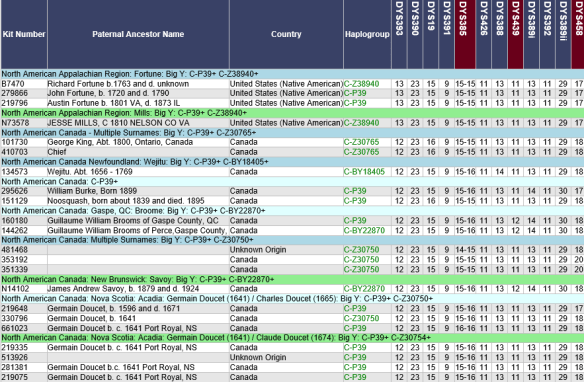
Some other popular mode to group larger haplogroup projects is by haplogroup subgroups for both Y and mitochondrial DNA. The popular R-L21 and Subclades projection where my Estes men are members, only I don't administer, is grouped in this way.

Ane of the nifty features of all projects at Family Tree DNA is mapping. Based on how the administrator subdivides the project, if they enable project mapping (please do), you tin can select groups to brandish to view subgroup clusters.

I just love this feature. You lot know there'due south a story behind this grouping that is relevant to the men who deport this haplogroup.
The A2 mtDNA Haplogroup project is grouped by subgroup. Some administrators go further and group by specific mutations within subgroup likewise, hoping they will someday form a new subclade.

Maps provide so much information. In this case, the map of the A2 grouping, with no A2+ (downstream) subgroups shows a dispersal throughout the Americas, plus one person in Kingdom of denmark.

Expect, what?
Denmark?
Of course, Denmark immediately raises a plethora of questions including whether the Denmark person has taken the full sequence test or has possibly misidentified their ancestor'due south original location.
Some people don't empathize that the matrilineal line is your direct female parent's mother's female parent'southward line on up until you run out of direct line mothers. They hear or understand maternal instead and select their well-nigh distant MATERNAL ancestor which may be anyone from their mother's side of the tree – and someone entirely unlike than their straight line MATRILINEAL ancestor.
Surname Projects
Surname projects play a different office than the projects mentioned above. Specifically, surname projects not only attract males with that surname who are candidates to test, they besides concenter anyone who has that surname in their genealogy who is looking to see if someone from their line has tested – because they can't.
All of us have a lot more surnames that aren't our direct paternal surname, which only males can exam via Y Dna.

In the graphic above, the surname lineage is blueish, the mitochondrial is reddish, and the colorless boxes represent all of our other lines.
Therefore, most people are looking at a surname project to find lineages they can't directly test for. Surname projects need to make it easy to find and locate lineages based on ancestors and location.
I don't know how many surname projects be, equally opposed to other project types, but I'd say surname projects outnumber the other types of projects significantly – significant at that place is a huge potential to find your surnames and ancestors in those projects.
I love surname projects, because even if y'all are a female or a male that doesn't deport that surname today, yous can still do good from the tests of people with that surname.
In the Estes project, which was formed for Y DNA, we also welcome autosomal joiners as long every bit they have Estes lineage someplace in their tree.
In the projection, I group Estes men past lineage from the immigrant Estes ancestor.

In social club to do this, I utilized the descendants of Abraham Estes to recreate his haplotype, and I compare everyone to those values, which represent the values that Abraham himself carried.

The good news is that by looking at the matches of each person in the project, you know who does and does non match each other. Family Tree Deoxyribonucleic acid tells you lot that. They exercise the hard lifting and y'all arrange the article of furniture.
I didn't know quite what to exercise with people whose genealogy and surname go back to Abraham Estes, or ane of his cousins who all descend from the Deal, England line – but their Y Dna unquestionably doesn't.

I created a "New Estes Line – Genetically Speaking" category. We can't say that these people "aren't Estes" because their mother may have been an Estes and gave her male child her surname, just not her Y Dna (which she doesn't take,) of course. That was contributed past the father. And then the surname is Estes, but the Y Dna doesn't match any of the Estes descendants of the Deal line. Notwithstanding, these people may match Estes descendants autosomally.
In that location is as well an "Estes Ungrouped" group, considering even though their Y Dna is clearly Estes, I can't connect these men back to a specific line still either through paper or Dna.

Assigning a member to the "Estes Ungrouped" group is dissimilar than leaving them in the default "ungrouped" catchall group provided by Family Tree DNA which is located at the bottom of the page. The default ungrouped group is where everyone lives until the administrator assigns them to a grouping.
Autosomal Joiners
There'due south been recent give-and-take about why administrators would desire to allow people to join Y DNA surname projects who've tested autosomally and descend from the surname line, but aren't males who comport the surname.
I am very much IN FAVOR of allowing autosomal joiners. Some other administrators, not so much. Someone recently said that they don't empathise why anyone who is not a male with the same surname equally the project would want to join – what benefit there could possibly exist. Equally a female person Estes, I can explain exactly why, in one simple graphic. OK, iii graphics.
On your personal business relationship myFTDNA tab, at that place'due south an Advanced Setting under "Tools and Apps." Click there.

Then select the Family Finder exam, and then "yeah" to "Show only people I match in all selected tests," then select the project. The project selected (Estes in this instance) must be one you have joined – that'south why information technology's of import to allow people from that lineage that don't acquit the Y chromosome to bring together.
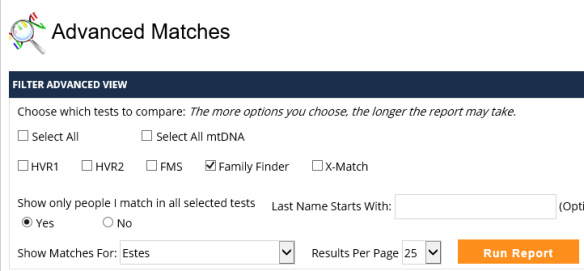
Want to approximate how many people I match, meaning Estes males AND all other Estes descendants who accept joined the projection? Click on the orange "Run Report" to see.

The answer is 23 people, although I've truncated the graphic. Some are cousins that I tested, but a dozen aren't AND in that location are a few that I've never heard of before. Hullo cousins! Does anyone have the family Bible or know where it is???
Clearly, I could match some of these people through other lines, Merely, at present I know where to start looking. Using the advanced tools like Paternal Phasing (bucketing), the In Mutual With (ICW) tool and the Matrix, available to everyone, will speedily tell me how I friction match these people. Y'all can read about how to utilize these tools here.
Project administrators have an even more than powerful matrix tool at their disposal.
This is exactly why I've elected to welcome autosomal testers into my Y DNA surname projects. The power of DNA is not just in a unmarried set of results, but in collaboration and combined tools.
Autosomal Projects
Autosomal projects, typically referred to every bit "private family projects" do exist, but yous can't run across them when you search by surname considering they don't testify up in searches, according to the Family Tree DNA policy.
I promise this policy changes in the near futurity, assuasive the option of searching for autosomal-merely projects. Admittedly, autosomal projects are challenging without any results to "show" in a display.
Therefore, in an autosomal project today, in order to grouping people, you must allow either the Y or mtDNA to "show" because members can't be grouped otherwise, and even and so, they must be grouped on ii independent pages – Y and mitochondrial.
The current project structure does not support creating an autosomal group, perchance by ancestor, and allowing projection members' ancestor from the Estes line to show, for example, given that it's not the direct Y or mitochondrial Deoxyribonucleic acid line.
For that reason, autosomal projects are private, just I would like for the administrator to be able to select public or private for autosomal projects and to have a dissever autosomal tab in the administrator'due south toolbox where all members tin exist grouped according to autosomal lines, independent of and in addition to Y or mitochondrial DNA if relevant.
This would likewise allow the cosmos of "antecedent projects," pregnant anybody descended from Robert Eastye (that becomes Eastes and Estes) born 1555 in Deal or Ringwould, Kent, England. Thinking alee, we could then go on to recreate his autosomal Deoxyribonucleic acid from project members, only like nosotros recreated Abraham Estes'south Y STR haplotype.

Here'due south an case of how autosomal results could be grouped, without showing whatsoever additional results information, in projects. I'll exist submitting this every bit a request to Family Tree Deoxyribonucleic acid!
This autosomal grouping challenge is present as well for Y Dna surname projects that allow autosomal joiners.
Some Group Don'ts, With a Dash of Humor
One of the things I practise roughly yearly is to peruse the public projects to see if any of my ancestral lines are represented or their haplogroup has been expanded. I recently finished this activity in one case again, so, here are a few of the frustrations I encountered that are entirely avoidable.
- Please Don't Make Projects Private
In that location is nothing more discouraging than seeing this:

Projects are a wonderful mode to recruit new members and if the project is private, y'all've disabled your all-time recruiting tool.
I'm non feeling warm and fuzzy about this project, and that'south no joke. The first matter this project administrator did was to hang a large "Go Away" sign out for me to meet. Ok, I'thousand going! No demand to ask twice!
Individuals select for their results to "show" or "non bear witness" publicly in projects. Yous don't have to exercise this for them. Really.

So please, be inclusive and whorl out the red carpet!
- Delight Don't Group Surname Projects by Haplogroup But
Delight don't group surname projects by haplogroup, at to the lowest degree non if you take any other option. Let's telephone call this the last choice or agony group methodology.
Recall, the most common reason people are looking at the project is to be able to detect their ancestors, or ancestral group, which may be predicated on location. No one, but no one, already knows the surname haplogroup or they wouldn't be searching for their ancestors in this manner.

Family Tree Deoxyribonucleic acid automatically groups by marker/color within subgroup, but if you're trying to see if your ancestor or line is represented in a project, information technology's nigh impossible to detect using the "group by haplogroup" methodology – especially with small subgroups. Y haplogroups can vary in their naming, depending on how deeply people have tested. For example, haplogroup R has thousands of branches. Some administrators group at the highest haplogroup level, and some group by the smallest branch level, which carve up groups of men in the same family line – considering not everyone has tested to the same level.

Of course, if you really don't know how these men connect, or don't have any idea about who descends from which ancestor, haplogrouping at the base haplogroup level (like R or J) may be the best y'all can do. Family Tree DNA will attempt to automatically group within your haplogroup subgroups.
If this is the case, y'all might desire to effort to recruit a genealogist with some specialty in this surname as a co-administrator. Hey, maybe someone from inside that surname project!
- Please Don't Group past Number of Markers Tested
OMG, please no. But no.

Grouping by number of markers tested makes it impossible to find line marker mutations that should be grouped together. For example, the men with a value of thirteen at marker DYS439, above, should exist displayed together because that is likely a line marker mutation – signifying descent from a specific descendant line of Charles Dodson in the red rows. However, since participant results are grouped past the number of markers tested, these men are displayed in different groups.
To effigy out which ancestral line that value of 13 descends from, yous demand a subscription to the Physic Friends Network.
- Please, PLEASE, Don't Show But Surnames and non "Paternal Ancestor Proper name"

How on world would I ever know if my Luttrell or Littrell line is represented hither. And why would an administrator cull to Non INCLUDE the Paternal Ancestor Column?
This ane makes me just want to pull my hair out. Yes, seriously! Going bald.
- Please, Name the Line

Give the lineage a name or description, non just "Lineage 1." It helps researchers determine if THAT John Jones is THEIR John Jones and it helps a lot to know who John Jones married, and when, if you know.
For instance, for Lineage i, put as much information equally you can find, or at to the lowest degree enough to unquestionably identify the line. For example, "John Doe born 1612 Sussex, England died 1683 Tukesbury, MA m Jane Smith."
This helps place specific lines. This is non Wheel of Fortune for ancestors. Don't brand me estimate, considering I may guess incorrectly – and in that location is no need for that when the information is (could be, might be, please permit it be) readily available.
Another hint is to apply color effectively. Possibly lines that have different known progenitors but still match genetically having the same surname, meaning the earliest common ancestor has not withal been identified, could be the same color.
Think this through ahead of fourth dimension and come upward with a naming and color scheme that works well for your project circumstances and goals.
Sometimes after you've worked with a project for some time, you realize that perhaps things could be organized better. Been there, done that – no t-shirt. Just re-do it.
- Or Worse Yet…
No surname AND no ancestor AND the lines aren't named. Yeah, really. This projection might as well be called "why bother" or "shoot me at present."
Yous can't fifty-fifty tell which surname this project might be, let alone place an ancestral line.

You know that quondam saying well-nigh serving as a bad example? Well, this is it!
- A Skillful Example
And because I don't want to leave on a negative notation – a actually good example of a surname project.

You can tell that this ambassador has spent a significant amount of time working on this project – and too encouraging members to enter their most distant antecedent information which is extremely useful.
Now this project looks inviting and welcoming. And no, in case y'all were wondering, I do not administrate this projection, but since faux is the sincerest form of flattery, I'chiliad going to review my own surname projects with this ane in mind.
Great job Hill projection administrator(southward).
Resources
Maurice Gleeson has produced two wonderful YouTube videos near project assistants and in item, member group.
How to Grouping your Projection Members using MPRs (past the way, an MPR is a "marker of potential relatedness," according to Maurice.
https://www.youtube.com/watch?v=A9JcvbFcgUI
How Y-Deoxyribonucleic acid tin help your One Name Report
https://www.youtube.com/watch?v=vOx971zy6LI&t=3s
In addition, Family Tree DNA but updated the Quick Start Guide for administrators which walks you through setting up a project. https://www.familytreedna.com/learn/projection-administration/quick-first-guide/.
Now, enjoy Maurice's videos and create the most friendly welcome mat possible.
______________________________________________________________
Disclosure
I receive a pocket-sized contribution when you click on some of the links to vendors in my articles. This does NOT increase the cost you pay but helps me to keep the lights on and this informational blog free for anybody. Please click on the links in the articles or to the vendors below if you are purchasing products or DNA testing.
Thank you lot and then much.
DNA Purchases and Gratuitous Transfers
- Family Tree DNA
- MyHeritage Deoxyribonucleic acid merely
- MyHeritage DNA plus Wellness
- MyHeritage FREE Dna file upload
- AncestryDNA
- 23andMe Ancestry
- 23andMe Ancestry Plus Health
- LivingDNA
Genealogy Services
- MyHeritage Complimentary Tree Builder
- MyHeritage Subscription with Free Trial
Genealogy Inquiry
- Legacy Tree Genealogists for genealogy enquiry
Source: https://dna-explained.com/2018/05/21/project-groupings-and-how-to-get-the-most-out-of-projects-at-family-tree-dna/

Post a Comment for "How to Give Full Access to Any Project Administrators Family Tree Dna"